- Introduction
- The Chantry School
- KM Free Grammar
- Malham
- Malham Girls School
- Scosthrop
- Malham Tarn
- KM United School
- Airton
- Lee Gate & Bordley
Clicking on most pictures will show a larger version
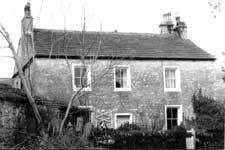
High Barn Cottage, supposed site of the Malham Girls School.

The History of Education in Malhamdale
Malham Girls’ School
There is some scant evidence for the existence of a school for girls in the Parish of Kirkby in Malhamdale as early as 1815. The Borthwick Institute has a series of Day School Returns made to the Archdeacon of York in the latter half of 1815 and the beginning of 1816. The return for Kirkby Malham parish is itself undated and unsigned but is identical in format to those that are, and states that there is a school for girls in addition to two principally for boys.
Day school Returns - Parish of Kirkby Malham
1st- What is the number of day schools in your parish; and what number of children attend them, distinguishing Boys and Girls?
Answer: There are three day schools in this Parish; two principally for Boys, and one for girls. The number of Boys who attend them is fifty three – the number of girls 38.
2nd- What Sunday Schools, and what number of Children are collected in them, distinguishing Boys and Girls?
Answer: There is one Sunday School, and the number of children collected is twenty Boys and Twenty five Girls.
3rd- Are they conducted in whole, or in part, on the National Society’s Plan of instruction?
Answer: Wholly on the old plan.
4th- When were they established, and how are they supported?
Answer: The Sunday School has been only recently established – the children find their own books and the Teachers attend voluntarily expecting no remuneration.
5th- If on the old Plan, are the present Teachers likely to be induced to learn and practice the new method?
Answer: No objection would be made to the new method.
6th- In that case, what number of Children are capable of being collected for instruction, within a walk of two miles?
Answer: There might be collected within this distance about a hundred children.
7th- What causes operate to prevent the adoption of the method of instruction recommended by the National Society – and how can they best be removed? With any general remarks that occur.
No answer given.
By 1818 the parochial return made to the parliamentary committee appointed to inquire into the education of the poor lists only the grammar schools at Kirkby and at Malham, with a total of seventy pupils attending, and makes no mention of a school for girls.
A Girls’ School certainly did operate in Malham in the years prior to the opening of the United School. This school was endowed with one thousand pounds by Thomas Clapham of Stackhouse in the Parish of Giggleswick. His will, dated 2nd January 1846 and proved at York on March 23rd 1846, bequeathed the sum of one thousand pounds to Thomas Preston of Scosthrop. The Charity Commissioners’ inquiry into the charities of the parish of Kirkby in Malhamdale held on June 21st 1893 long after the school had closed gives us detailed information about the endowment, describing it as Thomas Clapham’s Gift, although in later years it is often referred to as “The Malham Charity”. The inquiry report states,
“No trusts were declared of this sum, but Mr Preston, in pursuance apparently of an agreement made with the testator in his lifetime, applied the money to the endowment of a small school for girls, which was carried on in a cottage in the township of Malham”.
The general belief in Malham is that it was in High Barn Cottage and this is supported by the fact that Mr Ted Holmes, a former occupant, found a number of slate pencils behind the window seats.
The bequest was not actually transferred to Thomas Preston until April 28th 1852 by which time it had grown to £1037. 12s. 4d. and was invested in Consols.
We have not been able to ascertain precisely when the school was founded but when the Malham Free Grammar School was inspected in the 1860s the inspector, Mr J G Fitch, in his report, published in 1869, refers to a Girls’ School “recently established in the village under the care of a certificated mistress”. He also records that in 1864 nine girls had attended the Free Grammar School who had since entered the Girls’ School.
It has not proved possible to discover the name of the schoolmistress or the number of girls attending but the standard of education must have been better than the two grammar schools because Walter Morrison, in a letter to the Endowed Schools Commission of October 1869, describes it as “a fairly good school” whilst the grammar schools were described as inefficient and unsatisfactory. He even went so far as to suggest that the mistress of the Girls’ School might be considered as the interim teacher of the combined schools.
When the scheme was drawn up for the establishment of the United school it was obviously hoped to include the Girls’ School but certain conditions were imposed by Thomas Preston which the Endowed Schools Commissioners could not accept.
1. That the school be not more than halfway between Malham and Kirkby Malham.
2. That the endowment be applied to elementary education.
3. That he, Thomas Preston, become a life governor of the amalgamated school.
However these problems must have been addressed because shortly after the new school opened the Girls’ School did merge with it and the accounts for the United School for 1874/75 include an item of £146. 15s. 11d. received from Mr Preston being the accumulated balances on Malham Girls’ School account.
Although the income from the Malham Charity was applied to the new school and Thomas Preston became one of its first Co-opted Governors, the capital sum was not immediately transferred. Mr Preston died in the early 1880s and Mr James Hammond became the trustee. Eventually, in June 1892 the sum of £1037. 12s. 4d. became part of the general endowment of the United School.

